Legendary albums are legendarily difficult to review. But let’s have it, shall we?
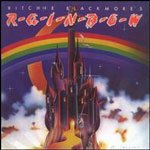
Rainbow came into being after Ritchie Blackmore made the shocking decision to leave Deep Purple, the highly regarded and substantially successful band he had co-founded and led. Casting around for his next move, Blackmore happened across the band Elf, featuring lead singer Ronnie James Dio, whose debut a few years previously had been produced by Deep Purple bass player Roger Glover.
Being Ritchie Blackmore, he managed to hijack the entire band—minus its unfortunate guitar player—and rename it Ritchie Blackmore’s Rainbow. After recording the group’s modestly successful self-titled 1975 debut, Blackmore and Dio proceeded to sack the rest of the band and recruit a top-notch trio of players behind them: Jimmy Bain (bass), Tony Carey (keyboards) and on drums, fresh from playing with Jeff Beck, the great Cozy Powell.
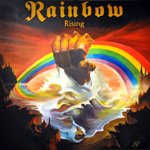
The result was an album that was once voted the greatest heavy metal album of all time (in a 1981 Kerrang! readers poll). If you’re really looking to start an argument, though, how about this: Rising might have represented the musical high-water mark for three different participants: Blackmore, Powell, and Dio. Regardless of where you stand on that assertion, what’s indisputable is that this album was the high point for Rainbow itself, as well as the template and/or inspiration for a substantial portion of the hard rock and metal that followed in its mid-’70s wake.
It could also be argued that this album is the first prog-metal album. You know there’s something different going on when the album opens with an otherworldly 75-second synthesizer overture, setting the mood before Blackmore enters with a hard-charging riff. “Tarot Woman” then introduces the lyrical and thematic focus of the album: medieval-flavored mysticism and black magic, subjects that intrigued both Blackmore and Dio and were part of their common creative language. You also hear Dio confidently stepping forward to establish himself as one of the iconic voices of heavy metal, with raw power and charisma aided by a natural overtone that’s unmistakably foreboding.
You can feel a little Deep Purple in the bones of “Run With The Wolf,” featuring a mid-tempo thump and churn spotlighting Carey’s Hammond organ. They put together a solid hook as well, leading up to Blackmore’s bluesy, rather deliberate and menacing solo. Then “Starstruck” arrives, a stone classic and in some ways the prototype for the whole album. It has some blues in its bones, but it’s hard-charging, with an excellent hook, a magical/mystical lyric, and Blackmore and Dio going all out. Next, Powell drives the even tighter and hookier “Do You Close Your Eyes,” which feels like the template for every hard rock radio single you remember, up to and including AC/DC’s “You Shook Me All Night Long.”
The prog-metal concept really begins to bloom in the second half. “Stargazer” stretches out to eight and a half minutes, with great flow and interest all the way, some terrific Blackmore soloing, and Dio singing his heart out. It’s another slightly silly wizards-and-castles lyric, but it all works together as part of the package, with Dio singing “I see a rainbow rising / Look there on the horizon” as they drive toward a majestic crescendo.
Closing cut “A Light In The Black” is another extended eight-minute number that opens with a headlong Blackmore riff with Bain and Powell driving hard underneath. Then Carey takes a strong solo, delivering some skronky, rather Emersonian tones before Blackmore answers. Eventually the entire group is just flying, verging on speed metal; you wonder if there’s going to be a fallback or respite of some kind, but it never arrives. The final jam leaves everyone, including the audience, breathless.
You want criticism? My hard rock fandom is mostly decades in the past, and Dio’s theatrical style has always felt a little over the top for me. Plus, while the lyrics are often clever, wizards and tarot aren’t really my bag. That said, it’d be foolish to knock the rating on this one down just because it isn’t precisely in my wheelhouse. Rising is one of the most influential hard rock albums of the ’70s, and for good reason. Horns up!